Wednesday, December 26, 2018

Woodworking InformationHow to Strip Wood Furniture

Woodworking InformationHow to Strip Wood Furniture

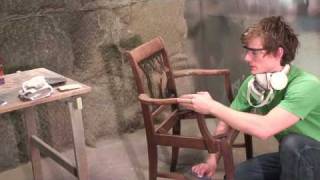
Now I'm about to demonstrate how to strip
a finish off of a piece of furniture. It's a bit echoey in here, but that's because we're
in the spray room, which sucks all the air towards this filter, keeping all the dust,
the particles of paint thinner and paint, any kind of floating materials that can be
in the air, going in one direction to keep the dust off the piece and to keep it safe
in the room, to breathe. Other precautions are, a respirator, gloves, and safety glasses.
The things we'll be using to do this process are paint thinner, paint remover, a wire brush,
steel wool, sandpaper, and some rags. This piece of furniture has flaking finish.

In
places it's completely worn out. In other places you have dirty build-up. We're going
to remove all that. The first thing we'll attack is the flaky paint, 'cause that's the
loosest, and the easiest thing to remove.

We'll do that using a wire brush, being careful
not to mar up the wood. When you're using a wire brush of any sort on anything flaky,
it's best to wear safety glasses and a respirator. Once you've used your wire brush to remove
any loose paint, then it's time to go to the next step. What we'll go to next is these
areas where the stain is still fairly well-attached, but it's worn away in the surrounding area.
This will be the next easiest thing to remove.

After you're done wire brushing the chair,
use some compressed air to blow any dust off of the chair. The next step is to remove any
actual build-up that's not able to be removed with the wire brush. We're going to be using
two things. We're start using paint thinner, and then if we need something stronger, we'll
use some of this paint remover.

I just tried using paint thinner with a rag. That didn't
seem to be enough, so I stepped it up to the steel wool. That also doesn't seem to be enough,
so now I'm going to try using this paint remover, which is a much stronger solvent. If there
seem to be areas that the paint remover and the paint thinner both will not remove due
to deeper staining, then you might need to take..Get a little more aggressive and use
something like a cabinet scraper to scrape back areas.

And then, reveal a little more
fresh wood. For demonstration purposes, I'm going to go ahead and stop here, but when
you're working on yours at home, just keep doing the same process all over the entire
chair until you get results that seem to appear to be like this..

Tuesday, December 18, 2018

Woodworking InformationHow to Bend Wood to Make Furniture

Woodworking InformationHow to Bend Wood to Make Furniture

Next I will be demonstrating how to bend wood.
This particular type of bend is called a bent lamination where you use multiple layers bent
around a form with glue in between, clamp down, when the glue dries, it retains its
shape. The first step is making your bending form. This particular bending form is made
out of three layers of three quarter inch MDF. First you cut your outside radius or
any shape that you want to bend to, then you cut an inside radius small enough to where
your clamps that you'll be using can reach over your form and over your piece that you
will be bending, clamping it down firmly.

The first step after building your bending
form is to now rip your strips. When ripping strips, you need to be aware that your strips
can be pulled down into your table saw through your throat plate. Replace your throat plate
with a zero clearance throat plate. Now it's time to rip the strips.

The first step of
ripping strips is to set the gage on the rip fence to the closest one eighth of an inch
mark that cuts the least amount of material off your wood as possible. Once again, the
first step is to set the rip fence gage to the closest one eighth of an inch increment
that cuts the least amount off your wood. Now we'll make that pass shaving off the edge
of the board. We will be creating one eighth of an inch strips.

The way you do this is
moving the rip fence gage one quarter of an inch each time. What that allows for, it allows
for the one eighth of an inch thickness of the saw blade plus gives you the one eighth
of an inch strip being sawed off the outside, which is the most safest and efficient way.
This process gives you nice, bendable, one eighth of an inch strips that if you follow
the method, it will give you each one will be very consistent. Repeat this method until
you have as many strips as you need. The next part of this process is the glue up.

You need
to make sure that you have all your things right around you because you only have a limited
amount of time to do a glue up like this because of how many glue seams you have. I've got
a roller for applying glue to the strips, all my clamps, and my bending form right here
where I need them. Now you need to take your roller, applying glue in the tray, roll glue
onto your strips. All you have to do is roll it onto the first one, have your stack in
front of you, roll a light amount of glue onto each strip flipping them onto each other
and continue this process until you've covered each strip with glue and have them evenly
stacked.

Next after the glue up is clamping all of your strips to your form. Whenever
possible, it's best to use a pad. In this case you're using small scraps of MDF to act
as a buffer between the clamp and your first strip. The reason for doing this is the amount
of pressure that the clamps can create can make marks or dent your wood, and then sometimes
if there's any glue on the surfaces, it can react with the steel leaving dark marks on
your wood.

First is find the center of the strips, place it on your form and get your
first clamp in place. Once you've done this, lay down, lay the form down along with the
clamp and your strips down flat. Repeat this process until you've reached both ends of
your strips. Bent laminations need to dry for approximately eight hours.

Once enough
time has passed, you want to un-clamp your form. If everything went right, you should
get a nice, consistent curve, the shape of your form..

Monday, December 10, 2018

Weekly Hebrew Words with Yaara - Furniture

Weekly Hebrew Words with Yaara - Furniture

Want to speak real Hebrew from your first lesson? Sign up for your free lifetime account at HebrewPod101.Com. Hi, everyone! My name is Yaara and this is Hebrew Weekly Words. Im really glad you joined us because the theme this week I think is really useful and its Furniture. So lets start!
(Shulkhan) table    .
(Kulam yoshvim misaviv la'shulkhan.) Everybody is sitting around the table.


(Kise) chair      .
(Ha'kise haze kaved yoter mishehu nir-eh.) This chair is heavier than it seems.  
(Madaf sfarim) "bookshelf    .
(Yesh meakhorai madaf sfarim.) There's a bookshelf behind me. See.
(Mita) "bed    .
(Ha'mita sheli raka meod.) My bed is really soft.


(Sapa) sofa Thats an easy one because its a bit similar, isnt it?
(Sapa) sofa        ?
(Ata yakhol la-azor li liskhov et ha'sapa hazot?) Can you help me carry this sofa? Thank you! Thats very nice of you. This is the end. Thank you so much for watching and well see you next week on Hebrew Weekly Words. Oh and dont forget to check out the site.

Bye!.

Sunday, December 2, 2018

This Guy Is Making Furniture and Buildings out of Your TrashNat Geo Live

This Guy Is Making Furniture and Buildings out of Your TrashNat Geo Live

- [Arthur] I hate plastic. That's why we've engulfed
on a 15 year mission to turn that into something
that we actually want. We have collected
around 750 new materials that's coming from our
daily post-consumer waste. It can go into any
consumer product at lower cost,
higher performance.

First of all, let
me show of hand who actually recycled
something today? Wow. Okay, this is a weird audience. But guess what, guess what? There's actually, in
the United States, we have the lowest
recycling rate of all the developed nations. It's plateauing at
34% recycling rate.

You look at the waste
here, it has tires, apparel waste, on top of
plastic bags and PET bottles. I think this is one
of a big problem here, no one actually wants
to be responsible for all that waste
that we're creating. We are responsible,
all of us here, are responsible for this mess. Our solution is, we
have to make trash sexy.

And this what National
Geographic is so good about. For us engineers, that
is engineering porn. Okay, so, why is that? Because this is the highest
performance animal in the ocean. It's the fastest,
it has the scale that's optimized for
speed, and it's just the pure physical
form is no waste.

Zero waste. Everything is considered,
everything is designed. But this is what we get,
every grain of rice, every wheat, every bread
that you eat has 20% waste. Fiber waste.

Every PET bottle, all
of these are perfectly nontoxic material that can
constantly be recycled, reused. And then we have
a growing e-waste. Electronic waste. Huge amount of it, it
has precious metals, it has a lot of toxic elements.

Let me get nerdy a
little bit here, okay? Why we are not turning
that into product, today, if you touch your
clothes there's no
recycled content in it. There's the seat
you're sitting on, the environment that we're in, has no recycled content in it. This is a problem. Why? Why not? The reason is because
the polymer chain got broken in the
recycling process.

Then how do you make
then strong again? If you're a weak animal, a
weak animal cannot be sexy. Maybe they are but, you
know they're not very sexy. So we are actually
drawn to pretty things. So how do you make
that sexy again? We have to use fiber
to bridge in-between.

And this is a, we
go back to history, the Romans built
cement aqueducts, Chinese built walls, all with agricultural
waste grinded down into these powder forms
they mix into the cement. What it does is, it has
silicon dioxide in it, amorphous silicon dioxide. It's a natural glue. It's actually forming
these broken polymer chains if you mix into it, it actually
starts to come together, conglomerates, into much
much stronger materials.

The ancient does it, why
aren't we doing that today? So that's one of
the solutions how we reinforce material
using organic waste. So why aren't we doing this? Toxicity. This is a piece of leather, and that's a piece of recycled
PET fabric on the side. Just look at how many steps
that's required to produce and process a piece
of leather fabric versus a piece of
recycled PET waste.

Every step requires a carbon
footprint, energy, chemicals. On the recycled PET
side, you only use water, heat, and knife to
cut the pieces down. Why aren't we doing this more? We invent seven new
materials a month, we have collected
around 750 new materials that's coming from our
daily post-consumer waste. But the problem is no one
wants to buy them, okay? So we have to pioneer
making up new applications.

So I'll show you very
quickly what we did. This is what we call
molecular cooking. Molecular cooking at all levels. Molecular gastronomy
at the marketing front, new pioneering, engineering, and designing, and
marketing fronts.

It can go into any
consumer product at lower cost,
higher performance. We have built 40
story tower with trash, campuses, nine story
tall building, museum, we just finished the biggest
e-waste recycling plant where we turn the
waste of a waste into all the
building's structure. We've worked on a food waste
recycling plant in Taiwan, and we are also
doing a car waste recycling plant that's
finishing this year. This looks like a
piece of marble.

It's not. It's right here. It's a piece
of recycled PET non-woven, no chemical added, heat
pressed, structural material, and it's also an air purifier. Okay, made from cigarette
waste, which is tobacco, which I smoked for many years.

Okay, it can be formed, shaped, into a lot of different formats, we turned it into this
in Milan this year. This is a pavilion,
it's actually inspired by the natural lung molecule. And that's actually
capturing formaldehyde in the air and it's
integrated with electronics. It's all interlocked,
single material, no glue, and I want you to focus
on the waste of the waste of that cigarette butt
production process, which are those chairs.

We actually turned that
into this furniture product using the
cigarette butts. So the product's called
"Anything Butt," okay? And this process allows
other designers globally to do even more different
types of furniture products. Please, this has to
look sexy to you now, because this is the leftover of a typical German
beer festival. Look at all that material
that's out there.

This is a possibility here. And we turn that, all
that crap, e-waste, food waste, recycled Nike
shoes, into recycled Nike store. In New York, you can go see, in Paris, Le Marais,
you can go see, in Milan, in London,
you can see all these stores that are
made from apparel waste and e-waste, and
any type of waste. We scale across 23 countries, taking portable
manufacturing machinery into developed world, because we want
to keep the trash in the developed world,
not to ship to India, China, Taiwan, anywhere else.

Thank you..